Saturday, June 20, 2009

1955 Ford Fairlane Crown Victoria 4 door Sedan


Uncle Dale actually shot me a note to tell me he likes my new iron, so I thought I would give the passersby the skinny on my new sign - the 1955 Ford Fairlane Crown Victoria.

According to How Stuff Works, the 1955-1956 Ford Fairlane Crown Victoria was the crowning gem of the bright two-tone and chrome era. One of the most imaginative cars of an imaginative decade, it took off for the heavens in looks -- but never in sales.

Ford's Crown Victoria, king of the new Ford Fairlane series, named after Henry Ford Senior's Fair Lane estate in Dearborn. The "Crown Vic," as it has been affectionately nicknamed, was a stunning "non-hardtop hardtop" featuring a stainless steel tiara (or "basket handle") wrapped over the roof of the hardtop body.

Ford prosaically called it a "bright metal roof transverse molding." Wrapping from the base of the B-pillar location over to the other B-pillar position, it was fixed -- so the Crown Vic wasn't really a "true" hardtop with an unobstructed side view.

Total 1955 Ford Fairlane production was 626,250 units, or about 45 percent of total 1955 Ford production. The number of Crown Vics was 33,165, plus 1999 Skyliner versions. Victoria production, at 113,372, underscored a public preference for Ford's traditional hardtop, which had been around since 1951. In 1955, this model listed for $107 less than the Crown.

The 1955-1956 model years stand as a unique period in Ford history, marked by excellent handling for the standards of the day, engineering that was better than most, and styling that has weathered the test of time. In fact. Crown Vic Skyliner models have been awarded Milestone Car status by the Milestone Car Society.

The Crown Victorias are truly the crown jewels of the Ford collection from that "Cherry Pink and Apple Blossom White" time period.

Thursday, June 18, 2009

Mountain Man Moose Tooth


This little scene is from the shadow box in the Latouche railcar. The portrait of the pioneer is from the Brown & Hawkins collection, circa 1907.

The tooth is from a moose's jawbone found in the spruce forest behind the railcar. After a few years the teeth have become loose, and this one fell out.

In order to stay healthy, a moose must eat 40 pounds (20 kg)of browse a day, and there are around 150,000 moose in Alaska. Several moose can be found chewing alders around the Hamptons.

Alaskan moose grow 8-10 ft long (240-310 cm) with a shoulder height of 4.6-7.8 ft. ((140-235 cm). They weigh between 440-1,815 pounds (200-825 kg) full grown. Only the males have antlers, with a spread up to 6.6 feet (2 meters) which weigh between 44-77 lbs. (20-35 kg) They usually live between 8-10 years, rarely more than 16 years.

Like range cattle, moose are unpredictable in their behavior. They have excellent hearing and smell, but poor vision. When moose perceive a threat they will often withdrawal silently into the trees and stand quietly until the danger has passed.

When they are startled they will crash noisily headlong through the brush reaching speeds of 34 mph (56 kmph). They hold their heads back so their antlers lie along the shoulders and the branches are pushed aside.

Moose are solitary creatures and do not form permanent groups. The only social bond formed is between mother and calf, and it is wise not to get between them. Russians, and early Seward pioneers, had some success domesticating moose for meat, milk, riding, and early draft work. In Alaska, this is no longer legal.

Moose is from "musee", an Algonkian Indian name. The Alaska Moose Federation encourages responsible conservation of this beautiful natural resource.

Tuesday, June 16, 2009

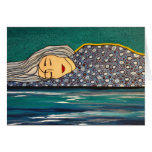
If You Were Born Without Wings


If you were born without wings, do nothing to prevent them growing. Coco Chanel.

From the Words to Live By series of original acrylic paintings by Dorene M. Lorenz. Click here to buy a print, magnet, postcard or other merchandise.

Original is available, priced at $500. To purchase contact Dorene M. Lorenz directly.

Saturday, June 13, 2009

Moonstruck Mukluks


The little scene is from the shadow box in the Latouche Railcar. The tiny mukluks are handsewn from seal skin, circa 1940s. They were part of my grandparents, Chris and Millie Sorenson's estate.

The photograph is of a young native couple in the Seward area, circa 1907. It is from the Brown & Hawkins collection.

The Qutekcak Native Tribe is the tribal organization for the Alaska Natives in the Seward area.

It is a unique native community made up of Alaska Natives who migrated to this area from all over the state. Members are Yupik, Inupiaq, Aleut, Tlingit, Alu'utiq, Siberian Eskimo, Passamaquoddy, Penobscot and Cherokee.

Seward is located in the Chugach Alaska Corporation area, one of thirteen regional corporations set up under the Alaska Native Claims Settlement Act (ANCSA) in 1972. A signifiant departure from the established federal Indian reservation system used in the Lower 48, ANCSA is a system of corporate ownership assets, and was developed to ensure long-term profitability and financial independence for Alaska Natives.

Today, Alaska's Native Regional Corporations and their subsidiaries are strongly represented in the Alaska Business Monthly's Magazine of Top 49ers - a ranking of the top Alaskan-owned and operated businesses. 23 of Alaska's Native-owned businesses generated over $8 billion in revenues in 2008.

Friday, June 12, 2009

Hamptons Wildflower Spotlight: Starflower


In the wildflower beds, as well as sprinkled through the estate, you will find the Alaskan broad-leaf starflower (Trientalis borealis ssp. latifolia). These seven petaled beauties are a forest loving groundcover.

The brilliant white flower is suspended upon an extremely thin stem, giving the illusion that the flower is floating above the lush green terminal whorl of leaves.

The flowers grow from 6-12 inches high, are shade tolerant
Asexual reproduction from the small tuberous rhizomes is more common than reproduction by seed. See can be collected in late summer, rhizomes in fall and winter. No action is required to break the seed dormancy, and the seed has a short shelf-life. Stratification results in delayed germination and extended germination time.

You should air dry the seeds for late summer planting in flats. Cover with 1/8" moist organic/sandy acidic soil. They like the soil to be loose, and to be planted in large clumps 2-4 inches apart. They flowers can be expected to live over three years. Dense patches will persist indefinitely and will expand as a self-sustaining colony.

Thursday, June 11, 2009

Mother hen, Walburga


I named her Walburga before I ever picked her up, the blue black splash orlington hen we bought from Sterling Meadows Hatchery. She is the most inquisitive of the bunch, and the bravest as well.

The Orpington is a large bird from the English class of chickens. It is a bold, upright breed with a wide chest, broad back, and small head and tail. The Orpington was bred as a dual-purpose breed (meat production and eggs), but its popularity grew as a show bird rather than a utility breed. Their large size and soft appearance together with their rich color and gentle contours make them very attractive. Wikipedia

I am told that they quickly learn tricks and come when their name is called. We are working on that one. Problem is that we keep calling her Burtha even though her name is Walburga.

Wednesday, June 10, 2009

New Sign Has Arrived


I know, it really looks like a 1950s Ford, but, honest, it is the new sign for the Hamptons. Anyone who knows me knows that I am big into re-purposing, it is part of my Alaskan pioneer heritage, so when Leif was complaining that he didn't want to take this car he found in the the woods to the dump - I volunteered to make it into a sign.

I actually volunteered my Dad, Marty Lorenz, to re-paint the rusted body and install some windows to keep the neighbor cats out of the interior. He offered to get the motor running, but on closer inspection decided it was going to be more work that he has energy for. Having that stroke has really slowed him down.

It is not a restoration, although the car is perfectly restorable. It is a saving of an asset until someone else decides that it is important enough to them to make an investment in.

Meantime, it is going to sit by Nash road advising folks where to turn to get to the Hamptons. If anyone is interested in taking this girl home and giving her a good second life give me a hollar, once we get a real sign we will ring you up and see if you are still interested.

Birds of a Feather


Rare Silver Dorkings, five hens and one rooster. We got them from Sterling Meadows Hatchery.

The Dorking is one of the oldest British breeds, descended from stock brought to Britain by the Ancient Romans. The Dorking is listed as vunerable on the Rare Breeds Survival Trust. It is a very rare breed, listed as threatened on the American Livestock Breeds Conservancy (ALBC) priority list. This means that there are fewer than 1,000 breeding birds in the US, with seven or fewer primary breeding flocks It is a globally endangered.

I was actually planning on getting some silkies this year, but Keith fell in love with the Dorkings. Dorkings were developed in Victorian times mainly as a table bird, having delicate white flesh with a long body and short legs. They are a docile breed but they do like to range.

Dorkings make good mothers and lay moderate numbers of good-sized tinted white eggs. Chicks can be sexed at hatch. Colors available are Silver Grey, Dark, Red, White and Cuckoo and features common to all of them are five toes and white legs. They are a classic dual purpose bird - they lay well, and are wonderful meat birds in addition to being a beautiful addition to your yard.

The five toe thing is funky, as it is an extra digit that is doubled up with another toe, not a equally spaced toe. They are really cute chicks, lots of visual texture, and very chatty. They are not as inquisitive as the Blue Black Splash Orphinton hen that we also picked up at Sterling Meadows, but more on her later.